
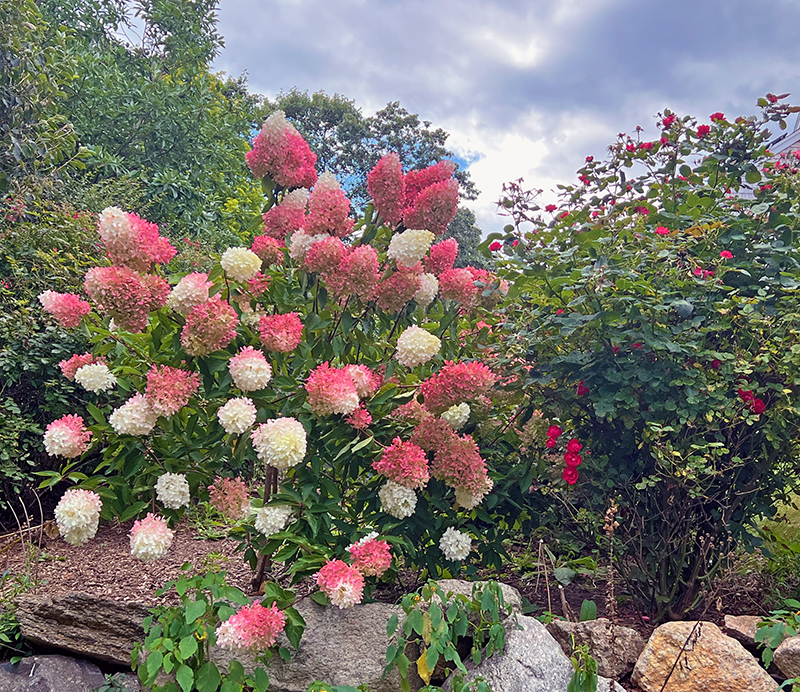
Q. My panicle hydrangea suddenly has some flowers that are different than the others. What’s going on?
A. It could be that your plant has self-seeded. Follow the stems under those different flowers down to where they come out of the ground. It’s likely that they will be a distance away from the original plant. You can either move that self-seeded plant or cut it to the ground to get rid of it. (We don’t have to save every volunteer plant… 😉)
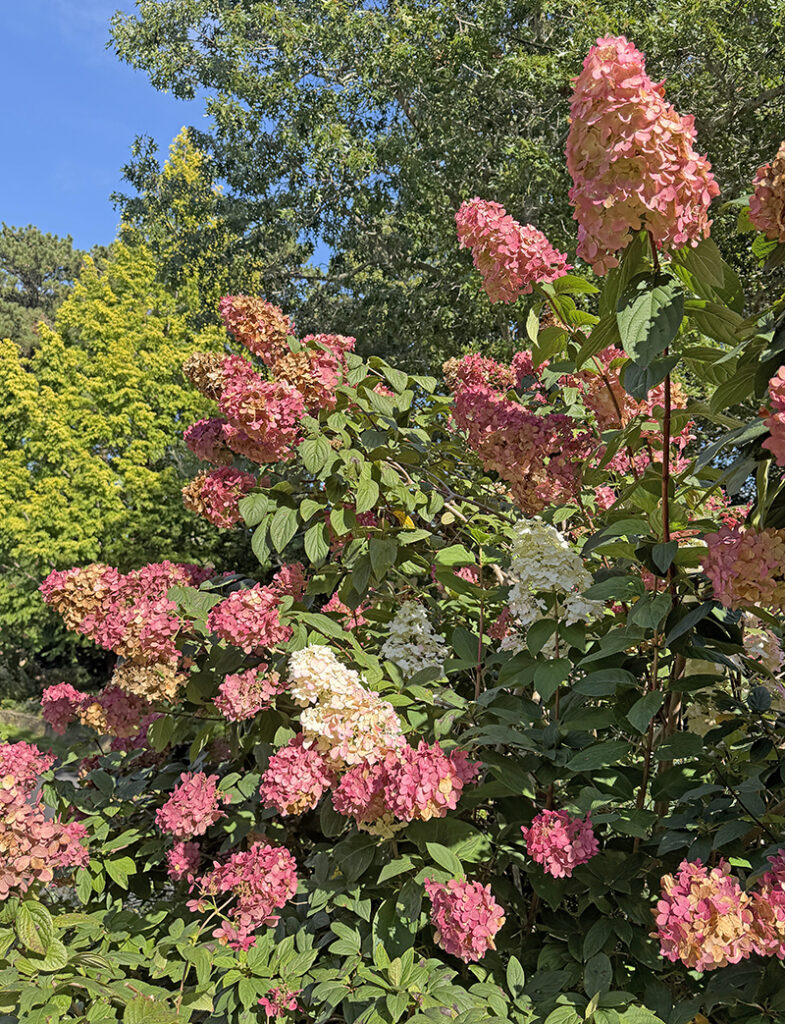
See the white flowers under my Fire Light hydrangea? They are on stems of a self-sown plant.
Q. Is it possible to keep my blue hydrangeas the lovely, sky blue into the fall?
A. While The Garden Lady loves those fresh, blue flowers on Hydrangea macrophylla shrubs, she encourages everyone to have appreciation for what we hydrangea geeks call “their antique phase.” Not only are the colors lovely, but the blooms dry well at this time of year.
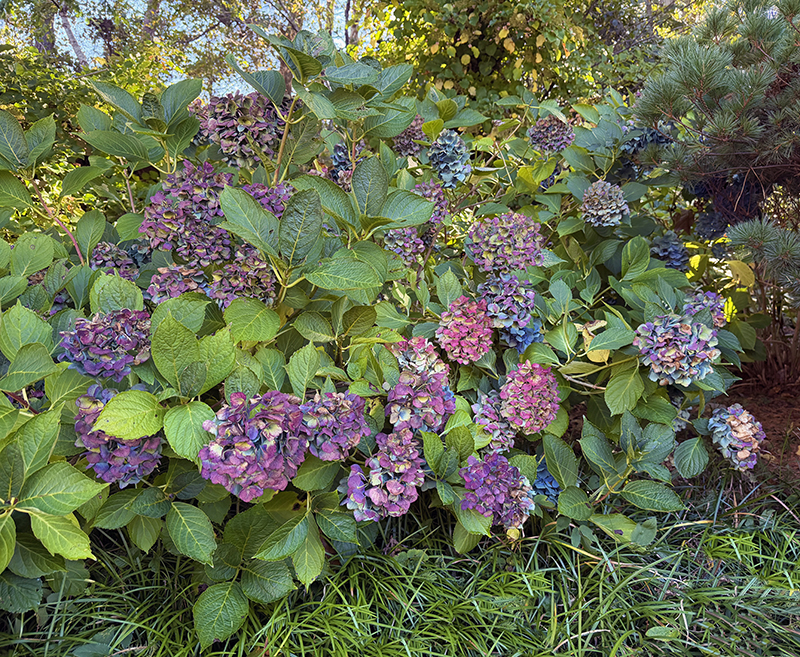
A friend and fellow plant geek once asked, “What’s your favorite Hydrangea?” I gave the usual non-committal answer of “Whatever I looked at ten minutes ago,” but he pressed on. “No, he said, give me one name. If you had to pick one…” Without hesitation I said, Mathilda Gutges. It’s kind of unfortunate that I love this one so much as it’s not easy to find anymore. The flowers are a deep sky blue in the summer – see the ones that are still that color, peeking out from the leaves. But their antique phase is lovely too, with shades of lavender, purple, blue and pink.
Q. Which hydrangeas are good for cutting and drying?
A. Many of them! Cut the panicles (H. paniculata), the smooth (H. arborescens), and the bigleaf (H. macrophylla) mopheads. Since the mountain types (H. serrata) are usually lacecaps they don’t dry quite so successfully, but they do have great winter interest when the old blooms are decorated with frost or snow.
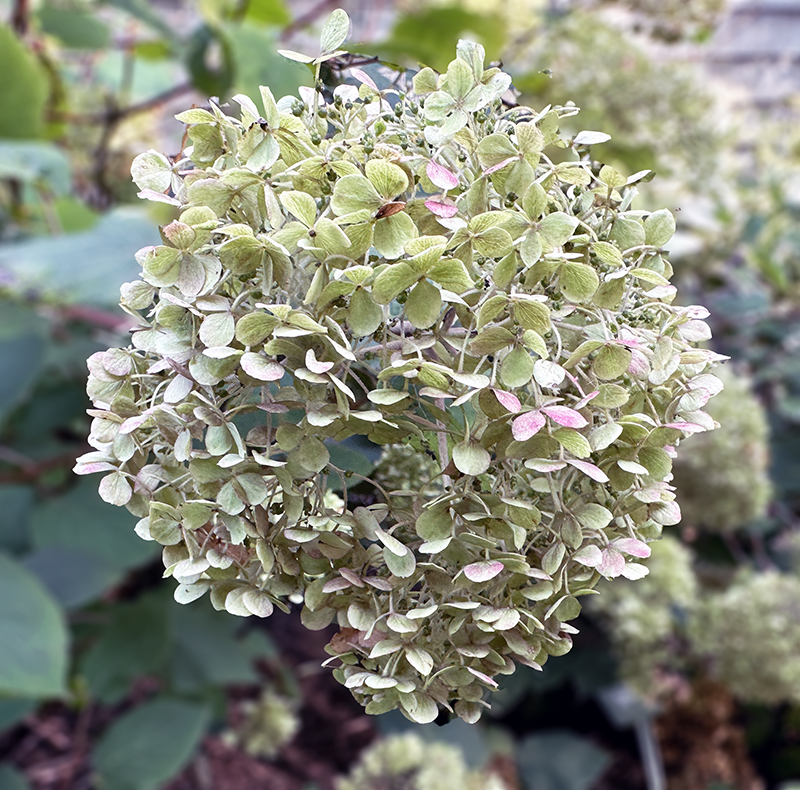
This is the pink arborescens, Invincebelle Spirit II, in September. It drys well and can be used in arrangements.
Q. I’d like a big-leaf hydrangea that’s dark blue or purple…
A. If you have acidic soil you can’t go wrong with Summer Crush.
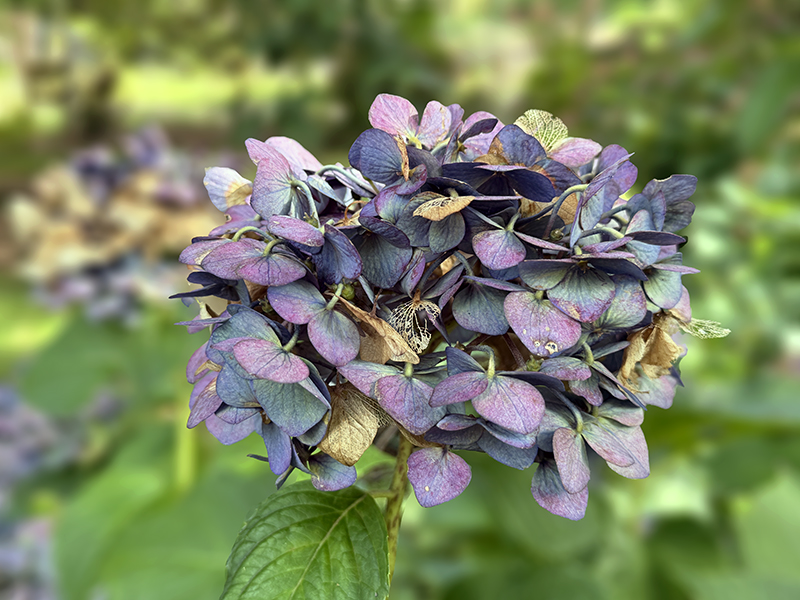
This is a Summer Crush flower in its “antique phase.” I not only like how the flowers turn from a deep blue to a range of blues and purples, but I am enchanted that as some of these sepals turn a golden brown, they also become lacy. Summer Crush is a rich pink in alkaline soil, dark blue to purple in acidic conditions, and it’s a favorite flower for picking and drying as well.
Q. Can I prune my bigleaf Hydrangeas down now? They are too tall and wide.
A. Don’t do it! First of all, you’ll be cutting off the flowers for next year because these plants have the germ of next year’s blooms on their stems right now. Secondly, the plant will just grow new canes up from the ground and be just as tall and wide by next July. Either live with the size it is or move it in early October.
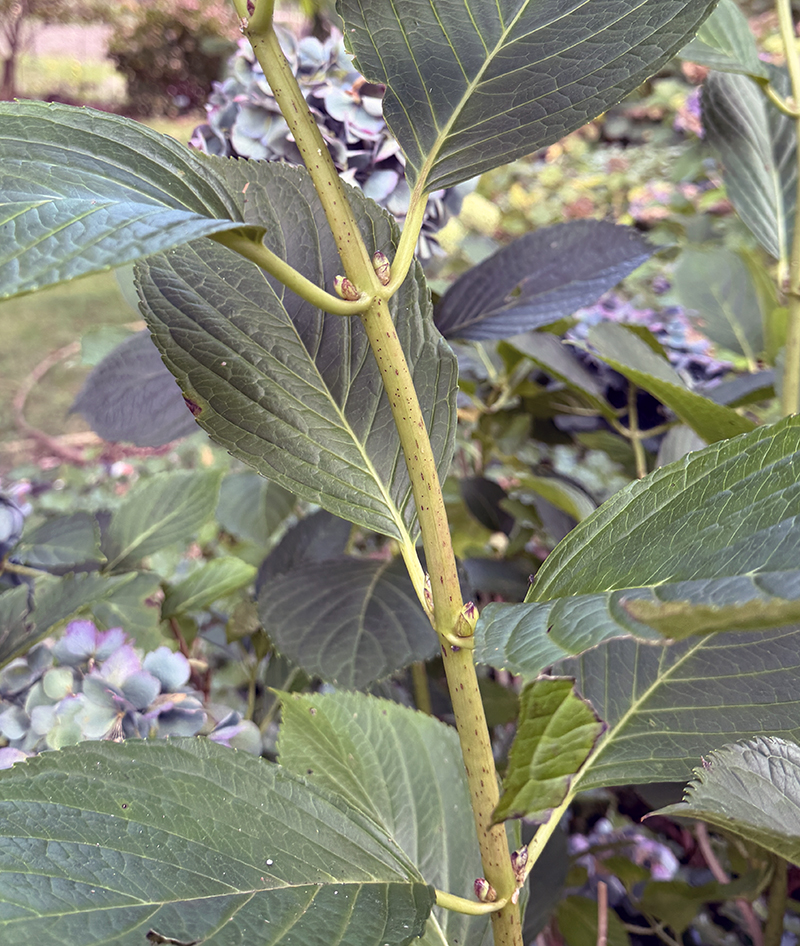
See those small buds where the leaf joins the main cane? Those contain the germ of next year’s flowers. There is no time when you can cut macrophyllas down without hurting the flowering.
Q. I see many people with panicle hydrangeas that are a lovely pink color, but mine just fade to tan. Is this a matter of adding something to the soil? Fertilizer?
A. While most of the macrophyllas will change color depending on the pH of the soil where they’re growing, panicles don’t do this. Whether a paniculata turns pink or red is a matter of genetics. Get a Fire Light, Pinky Winky Prime, Little Lime Punch or Strawberry Vanilla and enjoy the change from white to pink.
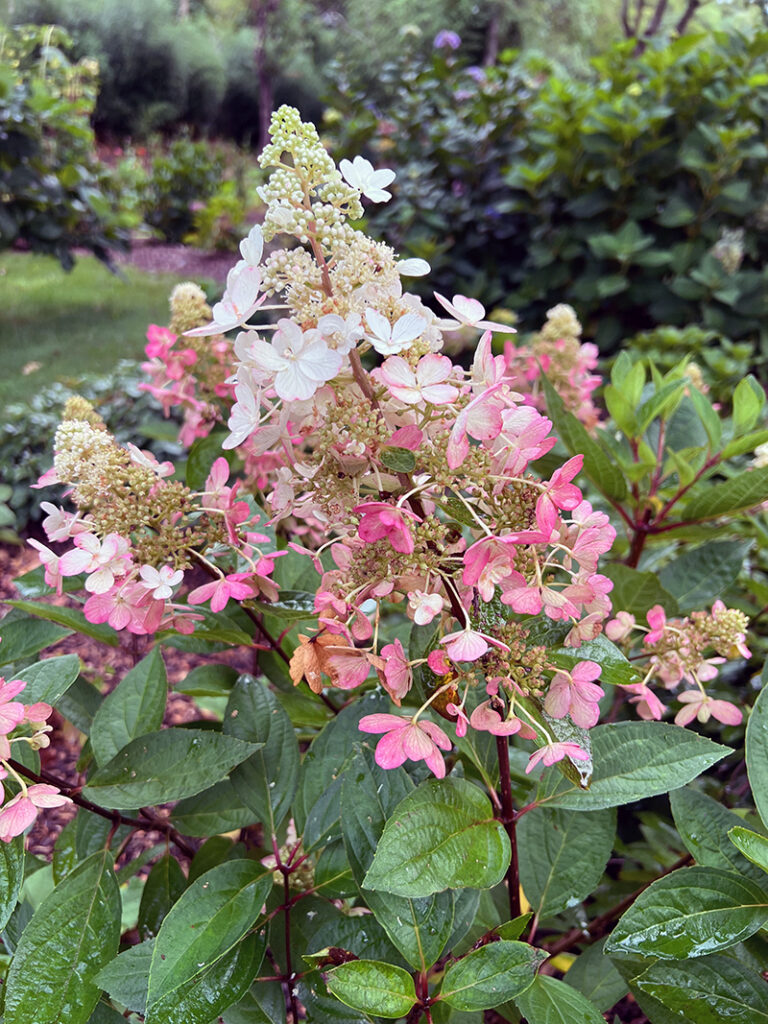
Pinky Winky Prime turns pink from bottom to top. Since the flowers are a bit lacy they don’t droop over, even after a heavy rain.
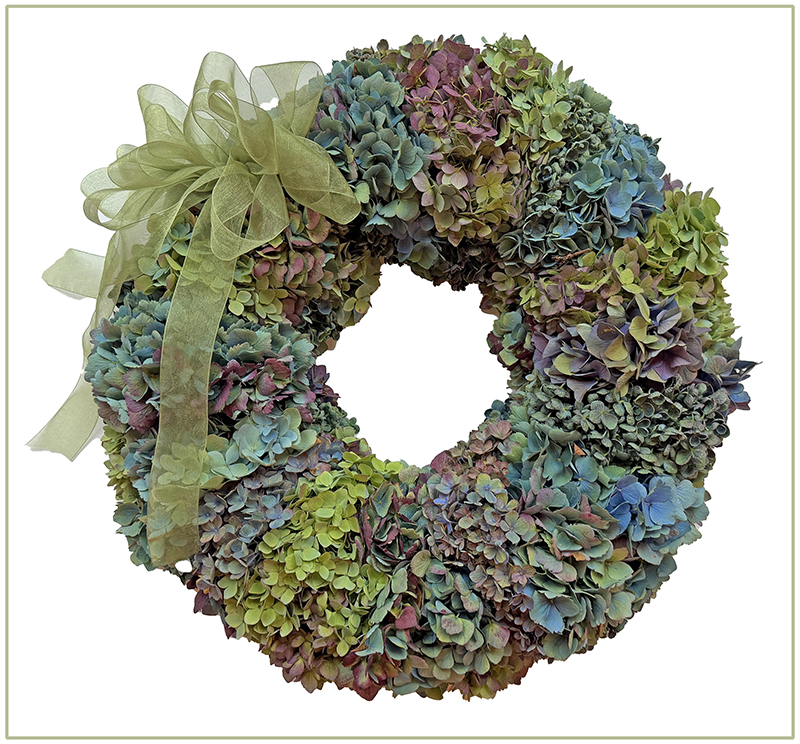
Q. I see posts about making dried hydrangea wreaths. Where can I find out how to do this?
A. There are many places online to find instructions, plus you might consider picking up a copy of my book, Hydrangea Happiness. I have included wreath instructions there, along with information about the six most commonly planted species of Hydrangeas.
0 Comments