
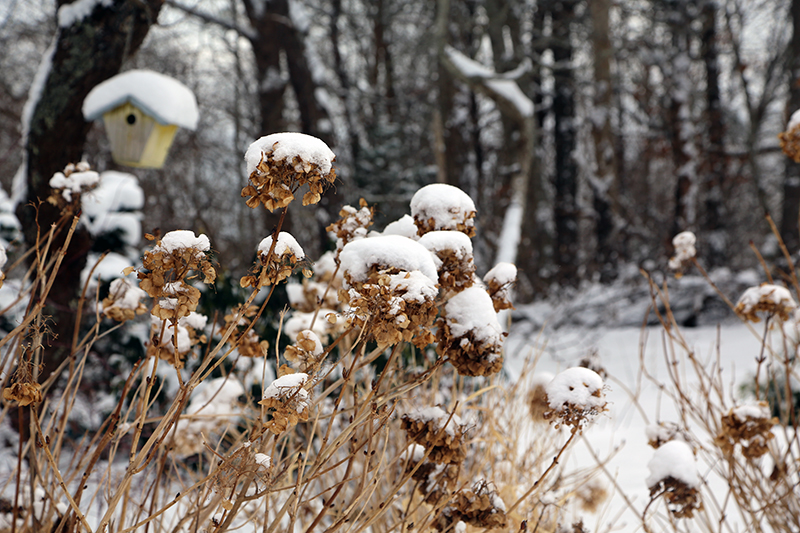
It was 8° F this morning when I got up, and the high is supposed to be 16°. This is what I call “Hydrangea dan-jah” weather. Plants such as the bigleaf hydrangeas (Hydrangea macrophylla) and mountain hydrangeas (H. serrata) form their flower buds in the late summer and blooming depends on those buds making it through the winter. Unfortunately, temperatures that fall much below 10° F for any length of time can zap those buds and kill the flowers. This always prompts people to ask if they should cover their plants to protect them. Here’s what I know.
Covering plants with blankets, tarps, or burlap doesn’t keep them warmer in such cold snaps. If the sun hits them during the day, the temperatures under the covering might be a tad higher, but those will fall to the surrounding air temperatures at night. Why doesn’t a cover keep the plants warmer? Because they aren’t generating heat. A down coat or a quilt keeps us warm because our bodies generate heat that those wraps hold…we heat the air spaces in that coat or quilt, and that heat is held close to us. Your hydrangeas aren’t generating any heat that a cover can trap.
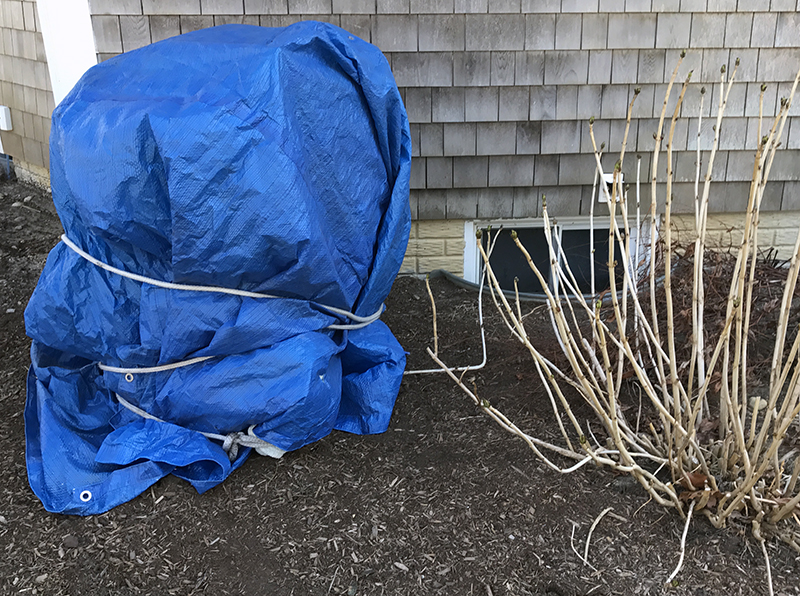
This hydrangea covered with a tarp is no better off in single digit weather than the uncovered plant next to it.
There are very few plants that generate heat, but one of them can be seen breaking through snow and ice in wetlands on Cape Cod and much of Eastern North America. It is Symplocarpus foetidus, the skunk cabbage. The flowers poke through ice and their warmth attracts any pollinators that are out early in the season. But hydrangeas don’t have such tricks up their stems.
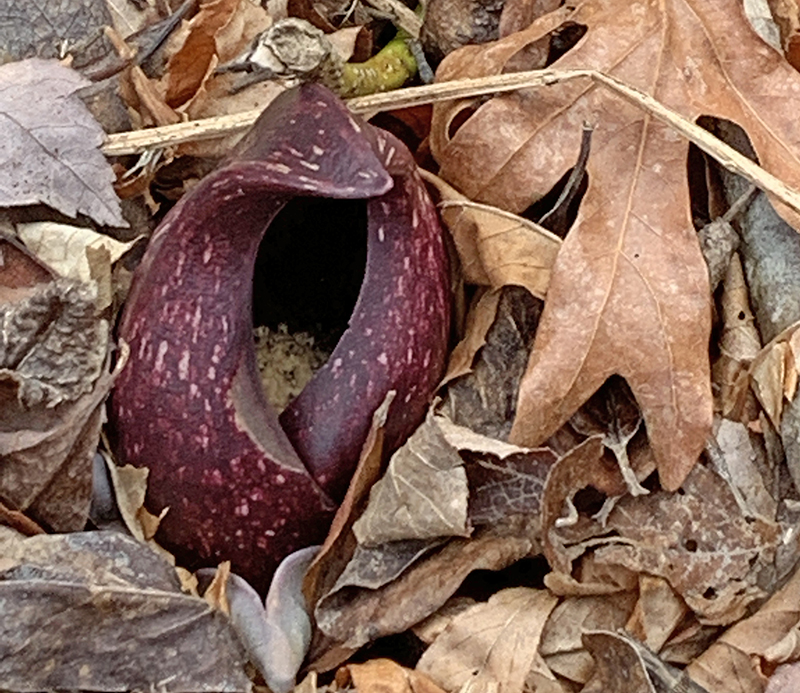
Symplocarpus foetidus (skunk cabbage) generates heat through a process called thermogenesis, where the spadix (the central flower spike) burns stored starch from its roots at a high metabolic rate. This rapid cellular respiration, similar to metabolic rates in small mammals, can make the spadix up to \(20^{\circ }\text{C}\) (\(36^{\circ }\text{F}\)), or even \(15\text{–}35^{\circ }\text{C}\) (\(59\text{–}95^{\circ }\text{F}\)), warmer than the surrounding air. Isn’t nature amazing?
If you built small greenhouses over your hydrangeas, those would keep the ground warmer as long as the sun hit them for part of the day, and that heat from the ground would be trapped by the greenhouse. But a blanket, tarp or even a cage filled with leaves or hay doesn’t do the same thing.
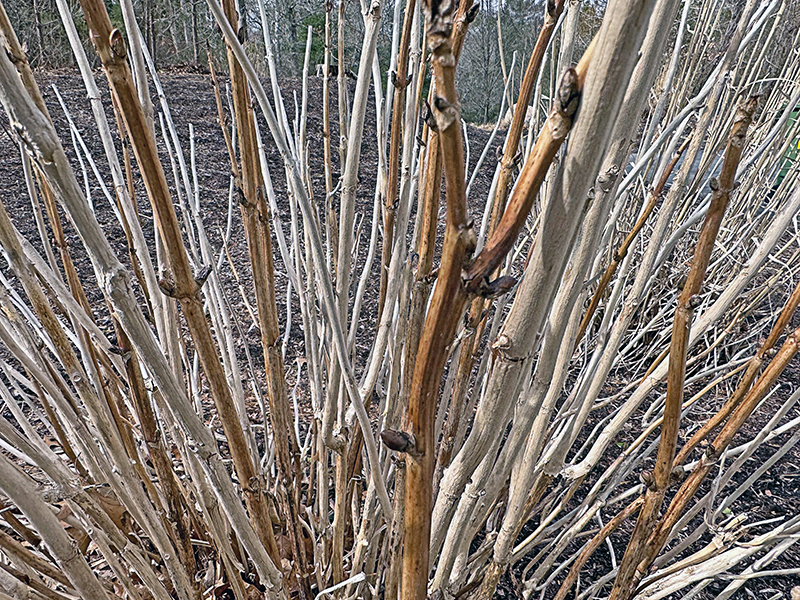
Those small buds on this hydrangea need to make it through the winter in order to flower. I won’t know until next May if they have survived or not. It’s out of my hands, so I’m not going to waste time or emotional well-being trying to control this.
I often say that prayer works as well as anything else for hydrangea protection, and you know what they say…all prayers are answered, but sometimes the answer is “no.” When it comes to winter weather and our hydrangeas, we get what we get and we don’t get upset. Or at least we try not to get upset.
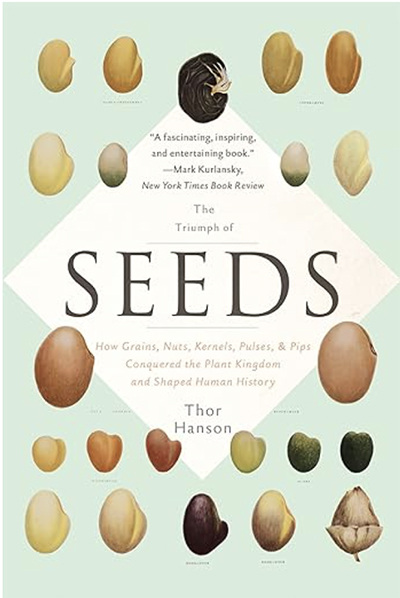
Instead of going outside with tarps or blankets, spend your time reading a good book about nature (one suggestion below), ordering your seeds, or planning your 2026 gardens.

My new book, Hydrangea Happiness, will be available in late-April. You can pre-order it on Amazon right now, but the book will actually land in the spring.
0 Comments