
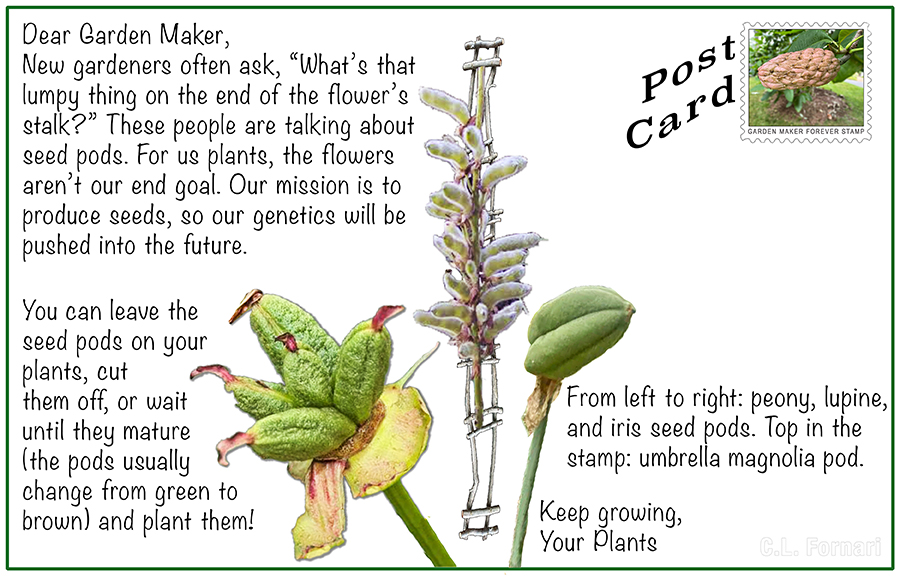
Today’s Postcard from Plants is about seed pods.
On The Garden Lady on the Fourth of July I featured several groups of four things to keep in mind when it comes to plants
FOUR THINGS THAT ARE IMPORTANT TO PLANTS
Photosynthesis — Converting light energy, water, and CO₂ into sugars (glucose) and oxygen. This is the foundation of nearly all food webs on Earth and the primary way plants produce energy for growth.
Respiration — The reverse of photosynthesis in some ways: plants break down sugars to release energy for cellular work. Unlike photosynthesis, respiration happens 24/7 in all living plant cells.
Transpiration — The movement of water from roots up through the plant and out through leaf pores (stomata) as water vapor. This drives nutrient uptake, cools the plant, and maintains cell turgor. A single tree can transpire hundreds of gallons of water per day.
Reproduction — Whether through seeds, spores, runners, or vegetative propagation, reproduction ensures species survival. In flowering plants this involves pollination, fertilization, seed development, and dispersal.
Some plant scientists would add nutrient uptake (absorption of minerals through roots) as equally essential, and others might highlight cell division/growth as a distinct process. So although stopping at four fits with the theme of the Fourth of July, it might be more accurate to list six.
FOUR THINGS ABOUT THE SOIL THAT GARDENERS SHOULD PAY ATTENTION TO:
Minimize disturbance. Heavy tilling and digging break apart soil structure and disrupt the fungal networks and microbial communities that hold soil together and cycle nutrients. Where possible, no-till or low-till approaches (broadforking instead of rototilling, leaving beds undisturbed between plantings) preserve that structure over time.
Keep soil covered and feed organic matter. Bare soil erodes, crusts over, and loses moisture fast. Mulching with compost, shredded leaves, or straw protects the surface, suppresses weeds, and breaks down to feed the soil food web. Adding compost or well-rotted manure regularly from the top down adds organic matter, which improves both water retention in sandy soils and drainage in heavy clay.
Keep living roots in the ground as much as possible. Roots feed soil microbes through exuded sugars, and cover crops (clover, winter rye, vetch) or just dense planting rather than leaving beds fallow help maintain that below-ground biology between main crops. In perennial beds, grow lots of plants in a community.
Test and balance soil chemistry rather than guessing. A soil test every couple of years tells you actual pH and nutrient levels, so amendments (lime, sulfur, specific fertilizers) are targeted instead of applied blind, which avoids both deficiencies and the buildup of excess nutrients that can throw off microbial balance.
TOP FOUR THINGS FOR HOUSEPLANT HEALTH
Light matched to the plant, not the room. This is the single most common failure point — people place plants based on where there’s an empty spot rather than actual light levels. A “low light” plant still needs some indirect light; a plant labeled for bright light in a dim corner will slowly decline even with perfect watering. It’s worth checking actual light conditions (north vs. south-facing, how far from the window) against what the specific plant needs.
Watering by the plant’s actual need, not a schedule. Use your fingers, eyes and brain to see when a plant is dry. Don’t just give the plant a little bit of water because you’re afraid of over-watering. When you water, saturate the entire root ball and let the excess drain into a good sized saucer. (Place pots with a built-in small saucer on a larger one.)
Drainage and appropriate potting mix. A pot without a drainage hole, or a dense mix that holds water too long, sets up root rot regardless of how carefully someone waters. Most houseplants want a mix that drains relatively fast; succulents and orchids need even more aggressive drainage than a standard potting mix provides. Never cover a drainage hole. Never put rocks, shards or other debris in the bottom of a pot.
Humidity and temperature stability. Many popular houseplants (ferns, calatheas, many tropicals) come from humid environments and struggle in dry heated/cooled indoor air, especially near heating vents or drafty windows. Brown leaf tips can be a humidity issue rather than a watering one.

The Stewartia tree is in flower in my gardens in early July.
0 Comments